How hard is the Preikestolen hike?
Why the elevation figure is a range
You will see anything between about 330 and 500 metres quoted for the climb, and both ends are defensible, because the trail dips as well as rises. It goes up, levels onto a shelf, drops into a marshy hollow, climbs again. Add the descents back in and you get a bigger number; measure the start and the finish and you get a smaller one. I say roughly 350 to 500 metres of climbing depending on how you count the dips, and I do not pick a single figure, because the sources do not agree and pretending otherwise would be tidier than it is true. One reviewer on a combined tour put it at 650 metres and said it should not be underestimated but was doable, which is his figure and his honest impression rather than a measurement.
What you are actually walking on
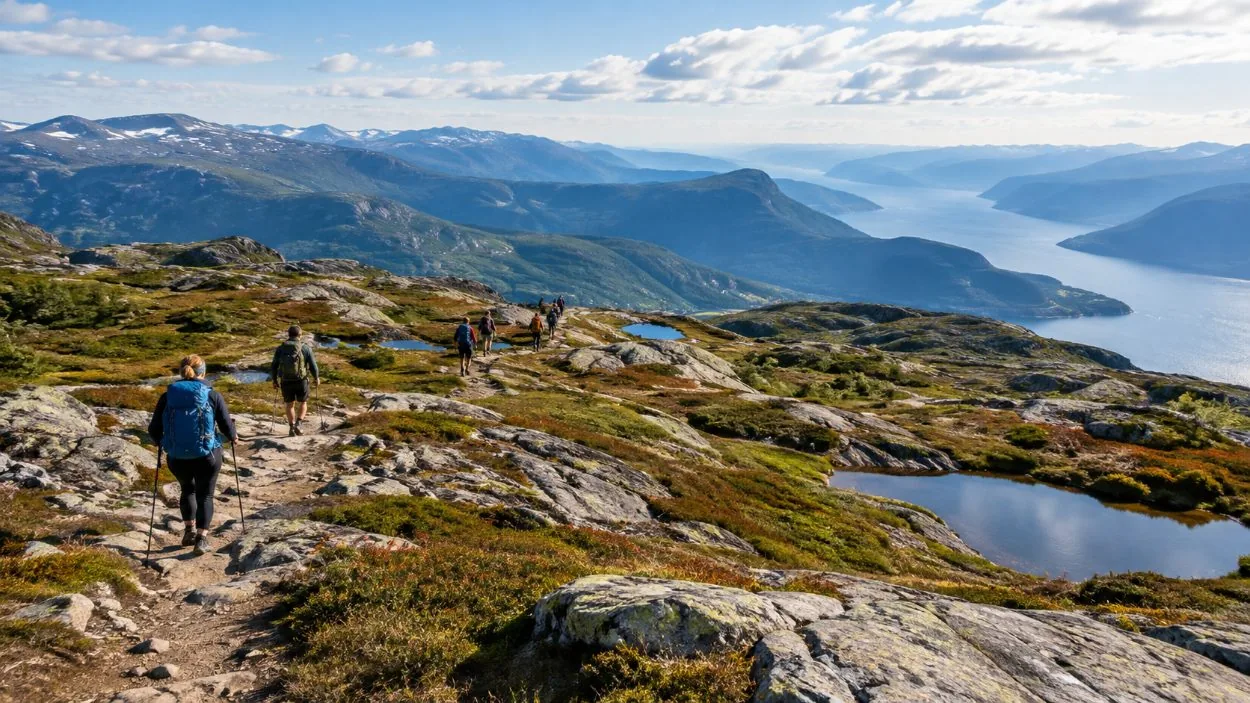
In order, because the order is the thing nobody tells you. Forest path first. Then stone staircases, many of them built by Nepalese Sherpa trail crews, who have worked on Norwegian paths since 2005 and ran a major project here between 2013 and 2016 with more work from 2019. Then boulder fields, which is where the pace collapses. Then wooden boardwalks laid over marsh. Then bare rock along the fjord edge for the last stretch. Five different surfaces, and only the first one feels like a walk in the woods. The stage-by-stage description is on the trail page.
The boulder sections are the honest answer to the question. You are placing each foot on an individual block, looking down rather than out, for long stretches. It is not dangerous in dry summer conditions. It is tiring in a way that a path is not, and it is why a distance that sounds like a two-hour walk takes four to five hours.
The way down is the hard half
This surprises people every year. Going up, you are fresh and the effort is your lungs. Coming down, you are tired, the same boulders now have to be stepped down onto rather than up, and your knees and ankles absorb every one of them. There are no published Preikestolen-specific injury figures, so I am not going to invent a statistic. What I can tell you as reasoning rather than data is that tired legs on uneven rock is how ankles turn and how knees give out, and that the calls for help I hear about locally are more often on the way back than on the way up. More on that on the injuries page.
Can you get lost?
In summer, no. The route carries the red painted T of the Norwegian Trekking Association, with distance posts roughly every 500 metres, and in high season there is a line of people in front of you. In winter it is a different trail with the same name: snow covers the markers, the cracks and the streams, and the rock ices over. That is the season when a guide stops being a nice extra: whether you need a guide.
What works
- No climbing, no scrambling, no equipment beyond boots
- Well marked and impossible to lose in summer
- Stone staircases on the steepest sections, built to last
- You can stop as often as you like; nobody is timing you
Worth knowing
- Four to five hours on your feet, which is the real cost
- Boulder fields where every step is a decision
- The descent is harder on joints than the climb
- Wet rock changes the whole calculation
- In winter it is a different proposition entirely
Take the descent seriously before you start it. Eat something on the plateau, tighten your laces, and accept that it will take nearly as long as the way up. The people who struggle are almost always the people who treated the top as the finish line.
If you want it harder, or emptier
The back-country route is longer, not shorter: roughly 9 km and about 500 metres of climbing on a rarely used trail through forest and over Neverdalsfjellet, joining Preikestolen from another direction with a maximum of eight people. People take it to avoid the crowd, not to save effort: the hidden trail. For the comparison with the harder Norwegian walks, see Preikestolen against Kjerag.
Booking a guided day
A guide will not make the boulders flatter, but a small group sets a sane pace and someone else drives. Availability below; the alternatives are on the bookings page.
A reminder about what that widget is. It books the ride out of Stavanger and, on most of these, a guide. It does not book Preikestolen. Nobody sells a ticket to the trail: it is free, open and unguided, and you can walk up it without paying anyone a thing.
Frequently asked questions
How difficult is the Pulpit Rock hike?
Moderate. No climbing and no exposure to negotiate, but about 8 km and four to five hours over stone steps, boulders and boardwalk.
How much climbing is there?
Roughly 350 to 500 metres, depending on how you count the dips. The trail descends as well as climbs, which is why sources disagree.
Which part is hardest?
The descent. Tired legs stepping down onto uneven rock is where people come unstuck: the injuries page.
Can a beginner do it?
A reasonably fit beginner can, with time and the right boots. A Norwegian reviewer put it plainly: 8 km there and back with sections that climb a lot, not easy for a complete beginner.